Back to Blogs
April 1st, 2026
Fleet Disaster Response Plan: What Every Fleet Manager Needs


Categories
Why You Need a Fleet Disaster Response Plan in 2026 — Before the Next Crisis Hits
For years, emergency preparedness was someone else’s problem. Fleet managers focused on uptime, fuel costs, and driver retention. Disasters were for FEMA to handle. That mindset is now a liability.
Hurricanes Helene and Milton tore through the Southeast in the fall of 2024, combining for more than $100 billion in damages according to NOAA, and paralyzing fleet operations across Florida, the Carolinas, Georgia, and Tennessee for weeks.
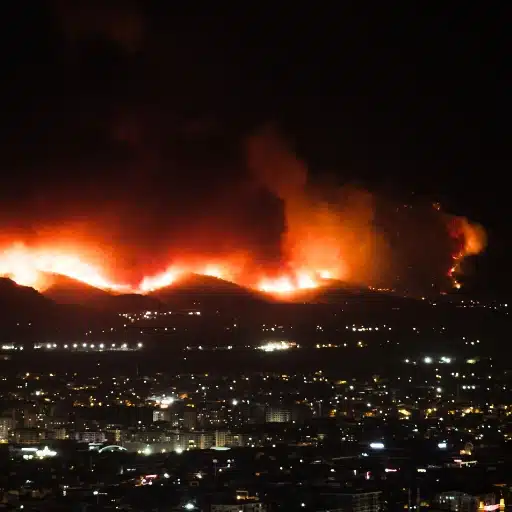
The Los Angeles wildfires in January 2025 forced the evacuation of up to 200,000 residents according to the U.S. Geological Survey, and brought commercial fleet operations across Southern California to a halt.
In June 2024, record flooding across Iowa, Minnesota, and South Dakota shut down major highways — including Interstate 29 — collapsed a railroad bridge, and disrupted public works operations simultaneously across the region.
And the lesson every fleet manager should have taken from each of these events is identical: the fleets that survived — operationally and financially — were the ones that had a written, practiced, living fleet disaster response plan before the first warning sirens sounded.
The ones that didn’t? They lost vehicles, lost contracts, and in several cases, lost the business entirely.
This is not a hypothetical future risk. This is the operating environment of 2026.
The Stakes Have Never Been Higher for Fleet Operations
Natural disasters are intensifying in both frequency and geographic reach. Wildfires now threaten fleets in states that never factored fire risk into their operational plans. Earthquakes remain an underplanned emergency scenario across the Pacific Northwest and Central United States. Hurricanes are arriving earlier, moving slower, and pushing further inland. Meanwhile, critical infrastructure failures — power grid outages, fuel supply chain disruptions, and cellular network collapses — compound every disaster event.
For commercial fleets, the financial exposure is compounding alongside it. A recent study estimates that unplanned fleet downtime costs operators between $448 and $760 per vehicle per day. Multiply that across a 50-truck fleet immobilized for ten days by a storm, and you are staring at a seven-figure operational loss before you account for vehicle damage, missed contracts, or liability exposure from stranded drivers.
Insurance alone is not a strategy. Emergency response is the strategy.
What a Fleet Emergency Response Plan Is
A fleet disaster (or emergency) response plan is not a laminated one-pager in the break room. It is a living operational framework that prepares your fleet, your team, and your assets to respond to various emergency scenarios with speed, coordination, and minimal improvisation.
Think of it as a business continuity plan with wheels. It answers the critical questions before the crisis forces you to answer them under pressure:
Where will vehicles be staged when a hurricane makes landfall?
Which employees are authorized to make emergency decisions when executives are unreachable?
What is the fuel protocol when the primary supply line is disrupted?
Which customers receive priority service, and who do you call first?
How do you communicate with drivers across multiple shifts when cell towers are down?
Fleets without answers to these questions don’t fail slowly. They fail all at once.
The Five Pillars of an Effective Emergency Preparedness Plan
Each of the following pillars addresses a distinct point of failure that real-world disasters have repeatedly exploited across commercial fleets.
1. Risk Mapping by Location and Asset Type
The foundation of any emergency response plan is an honest, location-specific risk assessment. A fleet operating utility trucks in Florida faces a different threat matrix than one managing delivery vans in California’s Central Valley or maintaining equipment across earthquake country in the Pacific Northwest.
Start by mapping every depot, parking facility, and operating zone against the primary disaster risks for that geography: hurricanes, wildfires, floods, ice storms, and earthquakes. FEMA’s National Risk Index, updated in December 2025, provides county-level risk data across 18 natural hazard categories that fleet managers can use to prioritize preparedness investment by location.
For each identified risk, outline the specific impact on fleet operations:
Which vehicles are at risk of physical damage?
Which routes become impassable?
Which fuel suppliers are in the disaster zone?
Which employees live in affected areas and may be unavailable for emergency shifts?
This exercise is the intelligence layer that makes every subsequent pillar of your plan actionable.
2. Pre-Positioned Assets and Fuel Strategies
Fuel is the most underestimated variable in fleet disaster preparedness. During Hurricane Helene in 2024, the U.S. Department of Transportation confirmed that fuel delivery to airports and fleet operators in Florida, Georgia, North Carolina, and South Carolina was severely disrupted due to storm impacts on fuel suppliers — grounding emergency response operations in the critical first days after landfall.
An effective fleet disaster response plan outlines:
Minimum fuel thresholds: Establish a policy requiring all fleet vehicles to maintain at least a three-quarter tank of fuel when a storm watch is issued. This single procedure, implemented proactively, eliminates a massive point of failure.
Mobile fuel contracts: Identify and contract with mobile fueling vendors in each operating region before the event. Pricing and access agreements negotiated in advance are exponentially more favorable than emergency arrangements made during a crisis.
Backup generator protocols: For depot facilities with fuel pumps, document generator capacity, fuel runtime, and maintenance responsibilities so the equipment doesn’t fail the moment it is needed.
Similarly, critical supplies — emergency signage, safety equipment, first aid kits, and communication devices — should be pre-staged by location, inventoried quarterly, and assigned to specific vehicles or team members.
3. A Communication Architecture That Survives the Disaster
Standard communication infrastructure — cell networks, internet-dependent dispatch systems, even landlines — degrades or collapses during major disaster events. Hurricane Helene’s official after-action review, conducted by the McChrystal Group for North Carolina Emergency Management, identified communication blackouts and the absence of pre-positioned resources as among the most critical operational failures during the response (North Carolina Department of Public Safety). This is precisely when communication matters most.
Your emergency response plan must outline a multi-channel communication strategy that doesn’t rely on a single point of failure:
Satellite communication devices for drivers in high-risk regions.
Pre-established call trees with direct phone numbers for every driver, supervisor, and key vendor, printed and physically distributed — not just stored in a shared cloud folder that requires internet access to open.
Designated out-of-area communication hubs, where a contact outside the affected region serves as the coordination point for inbound and outbound information.
Pre-scripted driver check-in protocols to ensure employees know exactly when and how to report their status during an emergency situation.
Fleets that communicate during crises protect their drivers. Fleets that go dark create both safety crises and legal exposure. When your driver is stranded in a flooded area, and dispatch cannot account for their location, the liability clock starts immediately.
4. Vehicle Staging, Repositioning, and Protection Procedures
One of the most preventable sources of fleet disaster loss is vehicles destroyed at fixed locations by storms or fires that were forecast days in advance. A written vehicle protection protocol eliminates this exposure.
The plan should outline, by risk type:
Hurricanes and flooding: Identify elevated staging locations, parking structures above flood plain lines, and inland repositioning routes for high-value assets. Establish a trigger point — for example, a Category 2 watch within 200 miles — that automatically initiates repositioning procedures.
Wildfires: Create a real-time monitoring protocol using fire weather alerts and the USFS fire detection mapping service to track perimeter movement. Define evacuation routes for vehicle convoys and assign repositioning responsibilities to specific team members.
Earthquakes: Post-event vehicle safety inspections must be documented before vehicles return to service. Establish partnerships with mobile inspection vendors ahead of time so your fleet isn’t waiting in line behind everyone else.
Ice storms: Identify covered or protected parking for priority assets. Outline anti-icing treatment schedules and pre-storm vehicle check procedures.
Repositioning costs money. Replacing totaled vehicles costs more.
5. Driver Training and Tabletop Exercises
A fleet disaster response plan that lives in a binder and is never practiced is barely better than no plan at all. The gap between a written procedure and an internalized response behavior is closed by one thing: repetition before the crisis.
Every driver and operations team member should be trained on:
Their specific role during each emergency scenario
What to do — and what not to do — at an accident scene during a disaster event
How to assess vehicle safety after a natural disaster before resuming operations
Emergency communication protocols and check-in procedures
At the operations and management level, tabletop exercises — structured walkthroughs of specific disaster scenarios with your leadership and operations team — should be conducted at a minimum annually, and ideally before peak risk seasons. Walk through a Category 4 hurricane scenario. Walk through a wildfire evacuation. Walk through a complete fuel supply disruption. These exercises consistently reveal gaps that no one identified during plan creation.
Fleets that conduct pre-season tabletop exercises respond faster, lose fewer assets, and resume operations days sooner than those that encounter disasters without practice. The difference is quantifiable.
Mutual Aid and Public Works Coordination
There is an underutilized strategic asset in fleet disaster preparedness: pre-established relationships with public works departments, emergency management agencies, and adjacent fleet operators.
Many municipalities are actively seeking private fleet partners for emergency response frameworks ahead of disaster events. In exchange for priority access to staging areas, fuel depots, or cleared routes, fleet operators can provide surge capacity for debris removal, supply delivery, or personnel transport.
These agreements are negotiated before the disaster. After it, everyone is managing their own crisis simultaneously. Fleets that have pre-existing coordination agreements with local emergency management or public works agencies gain access to resources — cleared corridors, priority fuel, real-time situational intelligence — that other fleets are scrambling to acquire.
Additionally, connecting with regional fleet manager associations creates informal mutual aid networks. The North Carolina Helene after-action review cited the absence of pre-existing vendor coordination agreements as a factor that severely hampered timely resource deployment. Fleets with established peer relationships and mutual aid agreements fared significantly better. Those operating in isolation had no such options.
The Regulatory and Legal Dimension
Fleet managers in 2026 face an additional layer of exposure that did not exist in previous generations: litigation tied directly to emergency preparedness failures.
If a driver is injured or causes an accident during a disaster event, and opposing counsel can demonstrate that the fleet lacked a documented emergency response plan, the absence of that documentation becomes evidence of negligence. It is the same spoliation and negligence logic that drives nuclear verdicts in standard accident cases — applied now to emergency operations.
Documentation is defense. An auditable, timestamped, regularly reviewed fleet disaster response plan demonstrates that the organization took its duty of care seriously. A missing plan — or one that hasn’t been updated since 2019 — tells a very different story to a jury.
The Time to Build This Plan Is Not During the Storm
The surge in climate-driven disasters, combined with the increasingly aggressive litigation environment facing commercial fleets, has made emergency preparedness a core risk management function.
Fleet managers must:
Map risk by location before the next event is on the radar
Pre-position fuel and supplies based on seasonal threat calendars
Build communication architectures that survive infrastructure failure
Train drivers and operations teams through tabletop exercises every season
Establish public works and mutual aid relationships before everyone needs them simultaneously
The fleets that will navigate the crises of 2026 and beyond are the ones treating disaster preparedness as a permanent line item — not an afterthought triggered by a weather alert. By the time the storm is in the forecast, the window for preparation has already closed.
Build the plan now. Practice it before you need it, and you’ll still be operating when the next disaster passes.
Don’t wait for the next disaster to expose the gaps in your operation — implement our field resource management platform that gives you the visibility and control to respond in real time.